
Homeschool Pre-Algebra Curriculum
Focused on Mastery
“With the help of TabletClass we finally have that ‘Ahh ha’ clicking moment when it all makes sense.”
TabletClass Math
A HOMESCHOOL FAVORITE!
Winner of the The Old Schoolhouse - Homeschool Review Crew's
Blue Ribbon Award for
FAVORITE HIGH SCHOOL Product

TabletClass Math
VOTED #1!
Winner of the 2022 Practical Homeschooling Magazine i-Learn Award for both MIDDLE SCHOOL and HIGH SCHOOL Math Curriculum

TabletClass Math makes homeschooling Pre-Algebra easy. We include the right amount of instruction your child needs to excel.
Our teacher, John Zimmerman, cares about your child’s success. He guides students every step of the curriculum with clear and understandable instruction that will help build their confidence in math.
Pre-Algebra Curriculum Summary
The pre-algebra curriculum is designed for the middle school student preparing to enter a high school level algebra course. Students entering this curriculum should have strong skills in arithmetic to include fraction operations.
The first part of Pre-Algebra will explore areas of real numbers (positive / negative numbers), solving equations, graphing and writing lines and inequalities.
Part 2 of the Pre-Algebra homeschool curriculum deals with topics such as functions and relations, systems, quadratic equations, polynomials, powers and exponents and rational / radical expressions. There are also sections on basic geometry to include circles, area, volume, Distance Formula and Pythagorean Theorem.
“TabletClass has been a lifesaver for us this year! My girls, freshmen this year, struggled with Pre-Algebra using another curriculum last year. Under the guidance of John Zimmerman, because he called me and talked to me when I ordered, and always calls personally when you email a question, we started over with Pre-Algebra again. It wasn’t long before we were caught up enough again to start with Algebra, and it is going great! My girls are on schedule to finish Algebra as if they were never behind. The curriculum is easy to follow and they are getting great, easy to follow, instruction. I am confident that Algebra II and Geometry will be attainable with homeschooling because of TabletClass. This curriculum has been a blessing and an answer to prayer. Thanks so much!”
-Sandy
Pre-Algebra Scope & Sequence
Chapters
Sections
Videos
Chapters
Sections
Videos
Chapter 1: Introduction to Algebra Terms and Concepts
This chapter introduces students to basic terms and concepts used in algebra. Time is taken to ensure the student understands basic number operations, variables and their applications. Additionally, the student gains a fundamental sense of equations, inequalities and their solutions.
Sections:
- 1.1 Number Operations
- 1.2 Variables
- 1.3 Order of Operations
- 1.4 Translating Verbal and Algebraic Phrases
- 1.5 Equations / Inequalities / Solutions
Chapter 2: Real Numbers and Simplifying Variable Expressions
This chapter focuses on getting the student to master working with the Real Numbers. Students learn the rules of integers and practice through many examples. Also, students will learn to apply the Distributive Property and simplify variable expressions by combining like terms.
Sections:
- 2.1 Real Number System
- 2.2 Adding Real Numbers
- 2.3 Subtracting Real Numbers
- 2.4 Multiplying and Dividing Real Numbers
- 2.5 Distributive Property
- 2.6 Simplifying by Combining Like Terms
Chapter 3: Fractions and Decimals
This chapter reviews how to work with fractions. Although it is assumed students posses these skills, time is taken to ensure the student has mastered the procedures to perform operations involving fractions.
Sections:
- 3.1 Introduction to Fractions and Decimals
- 3.2 Least Common Multiple / Denominator
- 3.3 Multiplying and Dividing Fractions
- 3.4 Adding and Subtracting Fractions
Chapter 4: Solving Equations
The chapter breaks down the steps to solve multi-step linear equations. Students will build up their skills as they progress from one and two-step equations to more advance equations. Core concepts involved will be reviewed to include the Distributive Property and combining like terms.
Sections:
- 4.1 One Step Equations
- 4.2 Solving Two Step Equations
- 4.3 Solving Multi-Step Equations
- 4.4 Formulas and Literal Equations
Chapter 5: Inequalities
In this chapter students will apply their equation solving skills to solve linear inequalities. Basic concepts and terms are introduced first, along with how to graph inequalities.
Sections:
- 5.1 Linear Inequalities
- 5.2 Compound Inequalities
Chapter 6: Graphing Linear Equations
This very important chapter walks the student step-by-step to master how to graph linear equations. Concepts involving the coordinate plane, slope and methods to graph lines are thoroughly reviewed and introduced. Upon completion of the chapter students will gain the necessary knowledge and skills needed to learn more advanced topics involving linear equations.
Sections:
- 6.1 Graphing Lines with One Variable
- 6.2 Graphing Lines with Two Variables
- 6.3 The Slope of a Line
- 6.4 Slope Intercept Method
- 6.5 XY Intercept Method
Chapter 7: Writing the Equations of Lines
This chapter builds on the student’s prior knowledge and skill of linear equations. Various methods to find and write the equation of a line are introduced and practiced. The chapter focuses on the proper way to set-up and use formulas to write linear equations. Additional related topics are explored to include linear models, linear regression and word problems.
Sections:
- 7.1 Using Slope-Intercept Form
- 7.2 Using Point-Slope intercept
- 7.3 Given the Slope and a Point
- 7.4 Given Two Points
- 7.5 Standard Form of Linear Equations
- 7.6 Best Fitting Lines and Scatter Plots
- 7.7 Linear Models / Word Problems
Chapter 8: Introduction to Systems
Understanding systems and the methods to solve them are vital in algebra. This chapter introduces the student to systems and what their solutions represent. Techniques to solve systems will build from the student’s prior knowledge of solving linear equations. Upon completion of the chapter a student will have a solid skill set in systems that prepares them for Algebra 1 and 2.
Sections:
- 8.1 Solving Systems by Graphing
- 8.2 Solving Systems Substitution Method
- 8.3 Solving Systems by Elimination / Linear Combination
Chapter 9: Absolute Value
Absolute value problems can be challenging for some students to grasp. Time is taken to teach students core concepts and build understanding. Students will learn how to graph absolute value functions and apply the steps to solve absolute value equations/inequalities.
Sections:
- 9.1 Introduction to Absolute Value
- 9.2 Graphing Absolute Value Equations
- 9.3 Solving Absolute Value Equations
- 9.4 Absolute Value Inequalities
Chapter 10: Powers and Exponents
This chapter covers the rules of powers and exponents a student needs to learn in algebra. Also, important applications of these rules are covered to include scientific notation, compound interest and exponential growth and decay.
Sections:
- 10.1 Product and Power Rules of Exponents
- 10.2 Negative and Zero Exponents Rules
- 10.3 Division Rules of Exponents
- 10.4 Scientific Notation
- 10.5 Compound Interest
- 10.6 Exponential Growth and Decay
Chapter 11: Polynomials
Polynomials are the key building blocks of algebra. The chapter starts by covering the parts of a polynomial and related terminology. Students then learn how to perform various polynomial operations, and a special focus is placed on avoiding common mistakes. Lastly, there is a section dedicated to introduce quadratic equations which are extremely important in more advance topics in algebra.
Sections:
- 11.1 Introduction to Polynomials
- 11.2 Adding and Subtracting Polynomials
- 11.3 Multiplying Polynomials
- 11.4 Introduction to Quadratic Equations
Chapter 12: Rational Expressions
This chapter takes the student through fundamental rational expressions to include ratios, proportions, percent and variation. Students will learn different methods to solve rational expression problems. The section on simplifying rational algebraic expressions starts by reviewing basic examples using numbers before introducing variable examples.
Sections:
- 12.1 Ratios and Proportions
- 12.2 Percent
- 12.3 Direct and Inverse Variation
- 12.4 Simplifying Rational Expressions
Chapter 13: Introduction to Functions and Relations
Functions and relations transcend all through mathematics. This chapter explains core concepts at the Pre-Algebra level and prepares the student for more advance study of the topic. Time is taken to explain the difference between a function and relation; and introduce the student to the language of functions to include the domain, range and linear/nonlinear functions.
Sections:
- 13.1 Introduction to Functions and Relations
- 13.2 Graphing Functions
- 13.3 Linear and Nonlinear Functions
Chapter 14: Area and Volume
This chapter explores the link between algebra and geometry. Basic formulas for area and volume are covered. Also, a section is dedicated to explain concepts related to circles to include area, volume, diameter, radius, and pi.
Sections:
- 14.1 Area of Basic Figures
- 14.2 Circles: Area and Circumference
- 14.3 Surface Area of Basic Figures
- 14.4 Volume of Basic Figures
Chapter 15: Right Triangle Theorems and Formulas
Properties of right triangles form the basis of many more advance topics in algebra, geometry and trigonometry. Sections in the chapter introduce fundamental theorems and formulas to include the Distance and Mid-Point formula and the Pythagorean Theorem.
Sections:
- 15.1 The Distance and Mid-Point Formula
- 15.2 The Pythagorean Theorem
Chapter 16: Data, Measurement and Probability
This chapter is a fundamental overview of how to work with data. Sections in the chapter introduce units of measures, conversion, mean, median, mode and range. Also, included is a section on graphs and plots such as box-and-whisker plots and frequency tables. Lastly, there is a section the basic concepts of probability to include a look into the Law of Large Numbers.
Sections:
- 16.1 Units of Measure and Conversion
- 16.2 Measures of Central Tendency- Mean, Median and Mode
- 16.3 Exploring Data- Charts, Tables, Graphs and Plots
- 16.4 Introduction To Probability
“Loving TabletClass. As a mom, I don’t have to worry if I am teaching algebra correctly which means I can focus on my younger daughter while my son is being taught by John. Hands off for me!”
-Keri
A Complete Curriculum Designed for Homeschoolers
TabletClass Math provides a full suite of comprehensive course support material with every membership at no extra cost.
See what’s inside…
Fully Explained Lesson Per Topic
The Lesson Video presents the key enabling concepts for the given topic. The video includes illustrations to help students visualize the concepts as well as the discussion of typical errors made by students. Lessons are in-depth offering objectives, and include a variety of problems with demonstration on how to solve.
These are not short, incomplete lessons that sometimes leave students frustrated and confused. We cover everything a student needs to learn on that specific topic.
Sample Video
Fully Explained Example Problems & Solutions
In addition to the lesson video, every topic includes example videos covering a wide range of problems on that topic. The videos are titled Example Set: A, Example Set: B, etc.
Problems are reviewed from basic to advanced and include word problems. They offer full explanations on how to solve, with each step demonstrated in the video. These videos help strengthen students’ proficiency on the topic.
Sample Video
Section Preview Worksheets cover all problems found in the Example Set videos. Ideally this file should be printed so the student can work on them either prior to watching videos, or along with the videos depending on how comfortable they are with the material.
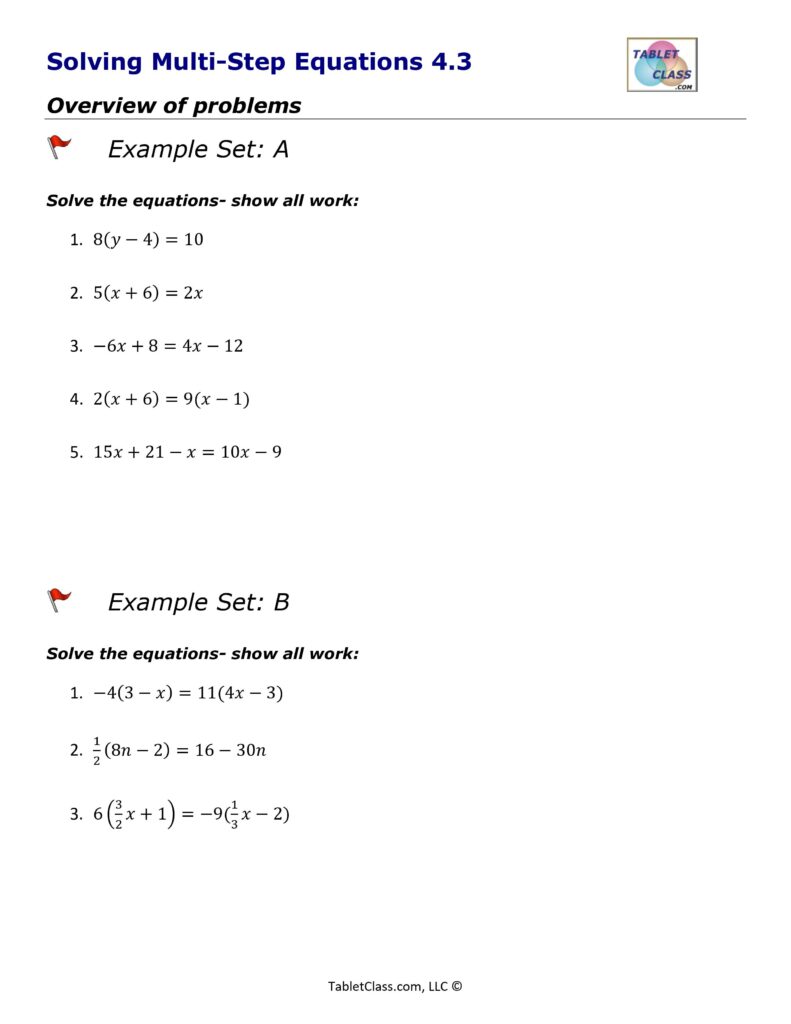
Resources included with every membership.
1. Section Worksheets:
- Full set of worksheets per section topic include problems and written answer keys with corresponding video solutions (aka Example Set Videos)
- Students can print worksheet assignments to work on prior to viewing corresponding solution videos or follow along with the solution videos
- 1000s of problems covered to include wide range of problem types from basic to advanced and word problems
- Designed to have students practice and fully master core academic skills
- Extra worksheets and answer keys available for added practice
Download Sample Section Preview
Download Sample Extra Practice
2. Chapter Notes:
- Comprehensive summary notes of all concepts covered within a chapter including specific steps to solve problems
- Designed to be a written learning reference for all course material (like a textbook)
- Perfect aid to study for quizzes and tests
3. Chapter Quizzes:
- Online quiz offers instant feedback includes answer keys, so students know what they need to revisit
- Designed to check for skill level, critical thinking, and overall comprehension
- Covers core academic standards
- Assessments are challenging and test for proficiency
Note: Chapter and final course tests are available in the optional Parent Resources.
All documents can be:
- Viewed in browser
- Printed
- Saved
(Requires Adobe Acrobat PDF Reader)
Comprehensive Lessons
Fully Explained Lesson Per Topic
The Lesson Video presents the key enabling concepts for the given topic. The video includes illustrations to help students visualize the concepts as well as the discussion of typical errors made by students. Lessons are in-depth offering objectives, and include a variety of problems with demonstration on how to solve.
These are not short, incomplete lessons that sometimes leave students frustrated and confused. We cover everything a student needs to learn on that specific topic.
Sample Video
Extensive Examples
In addition to the lesson video, every topic includes example videos covering a wide range of problems on that topic. The videos are titled Example Set: A, Example Set: B, etc.
Problems are reviewed from basic to advanced and include word problems. They offer full explanations on how to solve, with each step demonstrated in the video. These videos help strengthen students’ proficiency on the topic.
Sample Video
Bonus Resources
Included with every membership.
1. Section Worksheets:
- Full set of worksheets per section topic include problems and written answer keys with corresponding video solutions (aka Example Set Videos)
- Students can print worksheet assignments to work on prior to viewing corresponding solution videos or follow along with the solution videos
- 1000s of problems covered to include wide range of problem types from basic to advanced and word problems
- Designed to have students practice and fully master core academic skills
- Extra worksheets and answer keys available for added practice
Download Sample Section Preview
Download Sample Extra Practice
2. Chapter Notes:
- Comprehensive summary notes of all concepts covered within a chapter including specific steps to solve problems
- Designed to be a written learning reference for all course material (like a textbook)
- Perfect aid to study for quizzes and tests
3. Chapter Quizzes:
- Online quiz offers instant feedback includes answer keys, so students know what they need to revisit
- Designed to check for skill level, critical thinking, and overall comprehension
- Covers core academic standards
- Assessments are challenging and test for proficiency
Note: Chapter and final course tests are available in the optional Parent Resources.
All documents can be:
- Viewed in browser
- Printed
- Saved
(Requires Adobe Acrobat PDF Reader)
Ready to get started with Pre-Algebra?
Monthly Subscription – $25
(auto-renewal/cancel anytime)
6 Month Access – $95
(save $55 – one time fee/no auto-renewal)
12 Month Access – $150
(save $150 – one time fee/no auto-renewal)
Optional Parent Resources – $25
(Course Guidance & Tests – one time fee/unlimited access)
Not ready to buy?
See if your child is ready for this course or try our Free Course Demo.
“Our family has been using TabletClass for three years and plan on finishing up our homeschool math using this program. Our son completed Pre-Algebra through Algebra 2. Now our daughters are starting it. The concepts are taught in easy to understand bits. TabletClass is suited to students with a wide range of math abilities. The format is simple, clear and understandable. TabletClass tutorials make using the program comprehensible for even the most non computer savvy student or mom. Mr. Zimmerman uses an engaging style of teaching, making math less intimidating to non-math students, while gifted students are not bored. The students can set their own pace. The classes are available on a wide range of platforms. The program is very economical for any size family.”
-Sarah